

Get in the loop with Gwyneth, bend it like Beckham, and hit that joint.
How words make their mark on brands.

This issue of Wordmarks features a look at the hook it took to book the name of a newsletter turned global lifestyle brand plus two healthcare names that hinge on flexibility. Word. – Jason
POP CULTURE

Whoomp! (there it is)
Every morning, when I spot the goop beauty brand on my wife’s shower products, it fills me with joy. Those four letters carry immense significance and represent the potential of a simple concept executed flawlessly.
For those unfamiliar, Gwyneth Paltrow’s eponymous brand, intentionally lowercased, was derived from her initials, G+P, with the addition of two o’s at the suggestion of branding icon Peter Arnell. Legend has it that Arnell advised GP, “All successful internet companies have double o’s,” and thus, goop was born. Examples include Yahoo, Facebook, Google, and even Apple, who’s double p’s are just one letter away from o! The name was originally used solely for GP’s lifestyle newsletter and eventually grew to be known as her global lifestyle brand.
Double or repeated letters have been a branding strategy for decades. Kodak, with its beginning and ending with k’s, and Xerox, with its beginning and ending with x’s, are the epitome of invented names that leverage this mnemonic. These names feature short words with strong, crisp sounds at the beginning and end. During my high school days at Kinko’s (before its acquisition by FedEx Office), I recall a training video that delved into the founder’s fascination with the double-k in choosing their name.
Now, let’s return to goop. What truly brings a smile to my face is the literal transformation of the common word “goop,” defined as ‘a sloppy or sticky semifluid, often associated with unpleasantness’, into a premium brand. While most of the beauty products likely fall under the literal definition, once labeled as goop, they are elevated to a level of sophistication. This is the essence of the power of a great brand name.
In light of all of this theory, GP once revealed that she initially didn’t particularly like the name. She found it peculiar. However, to her credit, she placed her trust in the talented team around her and didn’t allow her immediate reaction to overshadow her decision. Branding can indeed sometimes be a dark art best left to the experts!
Short, distinct and already known words make some of the best and most memorable brand names.
UNSOLICITED FEEDBACK
Open sesame!
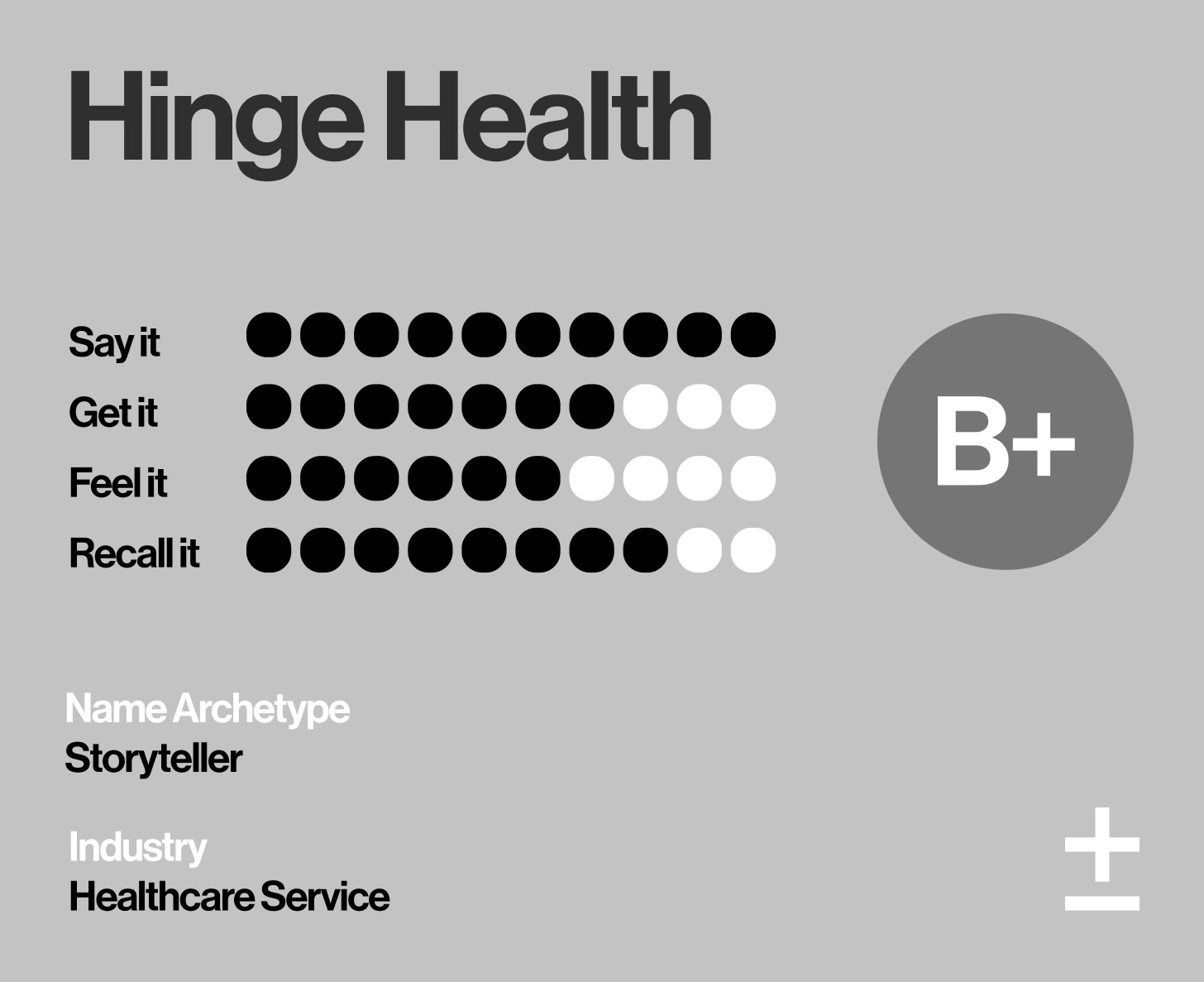
Hinge Health recently caught my attention with its straightforward and transparent brand name. They offer a digital physical therapy service to alleviate joint and muscle pain. The name immediately evokes the image of a folding hinge, symbolizing the seamless connection between their service and smooth, flexible joint movement. Upon further exploration, a secondary allusion emerges: successful physical therapy ‘hinges’ on consistent and repeated therapy—precisely what their service provides!
Even if we don’t immediately grasp the connection, the name’s direct and uncomplicated approach makes it highly memorable amidst the often convoluted healthcare names. Well done! (31/40) B+
Sometimes a name that literally and simply defines the service succeeds in delivering the most clarity.
—
My grading scale uses four factors, rated 1-10 (10 is perfect)
Can you say it? Is the name simple to say aloud?
Do you get it? Is the name’s meaning immediately clear?
Can you feel it? Does the name resonate with a unique character?
Will you recall it? How likely are you to remember the name?
BY MORESIMPLE

Kick it baby joint to joint*
I was approached by Primus Pharmaceuticals to help develop a name for their all-natural osteoarthritis medicine. The medication had shown promising results in human trials, and a name was needed to introduce it to the market.
The process of naming medications is complicated by government regulations that require names to be conversationally unique, meaning they are easy to distinguish when spoken. The client wanted a very consumer-friendly name because this product would be sold to the general public, not individuals with specific medical conditions.
Our exploration focused on the conditions and biology that the medicine impacted as well as the character of the improvements. Several themes emerged—pain relief and the applicability to joints in all of our hands, elbows, feet, and knees. The medication was providing relief across all of the patient’s limbs.
Relief for your limbs.
Limb relief.
Limb+rel.
Limbrel.
Limbrel perfectly encapsulated the medication’s promise in a concise, two-syllable word that was easy to pronounce. It became the top-selling product from Primus for a decade, and I was invited to name multiple new products as they were developed. What a relief!
Successful medication names help the consumer connect the medicine to the condition or the outcome.
*Let this be a warning that you can expect various Prince references moving forward.